Pine and oak are the two most common solid woods used in Polish kitchen furniture. They are different materials in almost every respect — density, hardness, grain structure, and how they respond to moisture. Understanding these differences matters when specifying furniture that will last in a kitchen environment.
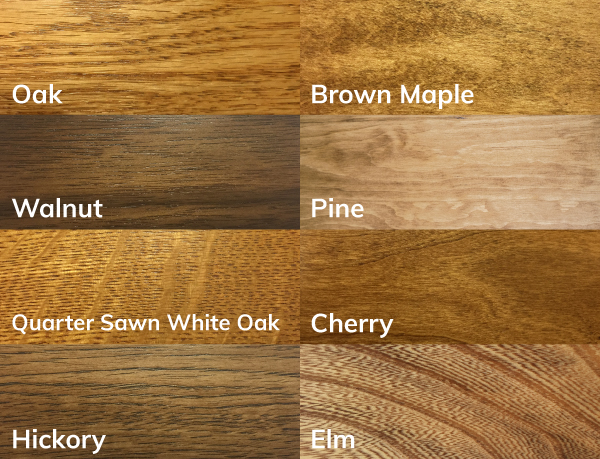
Pine in Kitchen Furniture
Scots pine (Pinus sylvestris) is the dominant species used in Polish solid-wood furniture. It is relatively light (air-dried density approximately 510 kg/m³), works easily with both hand and machine tools, and accepts stain and oil finishes without blotching when properly dried and sanded. Its softer surface means it will show dents from hard objects over time — this is a practical limitation in kitchen environments.
Moisture content and kiln drying
Pine furniture intended for heated interiors needs to be manufactured from kiln-dried timber at 8–12% equilibrium moisture content (EMC). Freshly felled or air-dried pine at 15–18% EMC will shrink as the heated interior dries it further, causing joints to loosen and panels to split. Most Polish furniture workshops use chamber kilns and verify moisture with a resistance-type meter before cutting. The target moisture range matches the interior EMC of Polish apartments in heating season — typically 35–50% relative humidity, which corresponds to 7–10% wood EMC.
Common joinery for pine cabinets
Cabinet frames in pine are typically constructed with one of three approaches:
- Mortise and tenon — traditional, high strength, requires dedicated machinery or skilled hand cutting. Used in high-end carpentry, less common in production furniture.
- Dowel joints — the production standard. 8mm or 10mm hardwood dowels with PVA adhesive provide adequate strength for cabinet carcasses. Requires a horizontal drilling machine for consistent hole alignment.
- Pocket-hole joinery — increasingly popular for frames and face frames. Fast and strong when used correctly, but requires accessible screw heads on the interior of the joint, which limits where it can be used aesthetically.
Pine panel behaviour
Solid pine panels wider than 200mm will move noticeably across the grain with seasonal humidity changes — up to 4–5mm per 300mm width. Door and drawer panels must be constructed to allow this movement: floating panels in grooved frames, not glued at the edges. Ignoring this leads to split panels within one or two heating seasons.
Oak in Kitchen Furniture
European oak (Quercus robur or Quercus petraea) is denser than pine (approximately 680–730 kg/m³ at 12% MC) and significantly harder. On the Janka scale, oak scores around 1290 lbf compared to around 870 lbf for pine. In practical terms, an oak worktop or drawer front resists scratching and denting at a level that pine cannot match.
Oak grain types in Polish furniture
Oak sold in Poland comes in two main cut categories that affect appearance:
- Plain-sawn (tangential cut) — shows the characteristic flowing grain and cathedral patterns. More variation between planks, wider boards available. Most common in kitchen furniture.
- Quarter-sawn (radial cut) — shows straight, consistent ray fleck pattern. More stable across the width, less prone to cupping. Harder to find in large widths, higher cost.
Joinery for oak components
Oak's density makes cutting and drilling more demanding on tools. Blades dull faster, and pre-drilling is essential before screwing to avoid splitting. For face frame construction, mortise-and-tenon or loose tenon joints (using a machine like the Festool Domino) are preferred over pocket screws, as the greater density of oak means pocket-hole joints can be prone to stripping on repeated disassembly.
Glue-ups for wide panels use edge-jointing with straight-line ripping on a jointer, then gluing with Titebond III or equivalent for its longer open time with dense wood. A biscuit or domino registration helps during clamping.
Finishing: Pine vs. Oak
Finishing choices differ significantly between the two species due to grain density and resin content.
| Finish type | Pine | Oak |
|---|---|---|
| Hardwax oil | Good — penetrates well, enhances grain | Excellent — food-safe, natural appearance |
| Water-based lacquer | Good — minimal yellowing | Good — but raises grain, needs extra sanding |
| Oil-wax (linseed/tung) | Acceptable — resin-prone knots may bleed through | Excellent — traditional choice for oak |
| Polyurethane varnish | Not recommended — hides character, cracks with movement | Acceptable for floors, poor for furniture |
| White stain / lye treatment | Good — popular in Scandinavian-style interiors | Excellent — classic lye + white soap finish used in Danish tradition |
For kitchen furniture, hardwax oil is the practical standard — it is renewable (can be spot-repaired without full stripping), water-resistant when properly cured, and food-safe when dry. Products from Rubio Monocoat or Osmo Polyx are used widely in Polish workshops for both pine and oak.
Structural Applications by Wood Type
Where pine works well
Pine is well-suited for cabinet carcasses (the body of the unit, which is not directly touched), internal shelves where the load is moderate, and decorative panel elements where the lighter colour is preferred. It is also the standard choice for painted kitchen furniture — pine takes primer and paint smoothly and the lower cost relative to oak makes it the practical base for any white or grey painted kitchen.
Where oak is preferred
Oak excels in high-contact surfaces: door fronts, drawer fronts, worktops, and open shelving where items are placed and removed daily. Its resistance to surface damage extends the visible life of the furniture significantly. Oak is also the material of choice for any visible internal component in open-shelf kitchens — pine shelves will show wear within a few years in a busy kitchen, while oak shelves remain presentable for decades with basic maintenance.
Mixed-species construction
Combining pine carcasses with oak fronts and worktops is common and structurally sound, provided the two species are not glued directly to each other across the grain — their different movement rates would cause joints to fail. Connection should be mechanical (screws, dowels, concealed fixings) to allow independent movement.
Sourcing standards in Poland
Polish pine lumber is graded under PN-D-95009 for structural timber and PN-EN 1316 for hardwoods including oak. Furniture-grade solid wood is typically sold as class I or II, referring to knot size and frequency, grain deviation, and surface defect limits. For kitchen furniture components wider than 150mm, edge-glued panels are common — these are stable, cost-efficient, and widely available from wholesale timber suppliers across Poland. FSC certification is available on most Polish-sourced timber and should be requested where environmental chain-of-custody is relevant.

